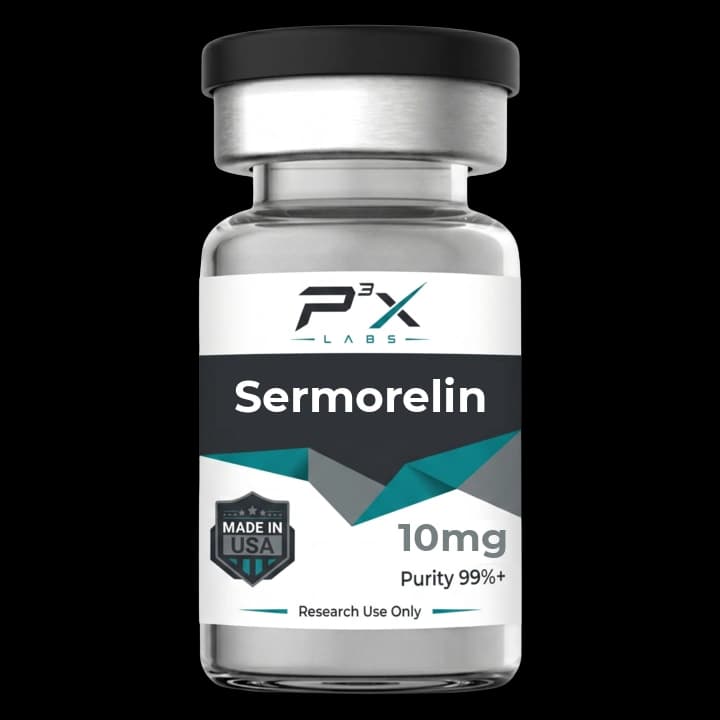
Sermorelin and GHRH Receptors
Sermorelin is thought to interact with GHRH receptors through complex molecular mechanisms, possibly triggering various cellular signaling pathways. It is hypothesized that upon binding to the GHRH receptor, Sermorelin may alter the receptor's structure, potentially initiating a series of intracellular signaling events. Some researchers propose that Sermorelin might enhance the production of cyclic adenosine monophosphate (cAMP) in specific cells, possibly through the activation of adenylate cyclase, which is suggested to convert ATP into cAMP.
Signaling Pathway
Higher levels of cAMP might lead to the activation of protein kinase A (PKA), a key enzyme in cellular signaling processes. PKA might phosphorylate various target proteins, thereby initiating further cellular responses. The potential activation of the GHRH receptor by Sermorelin, along with the ensuing cAMP-PKA signaling cascade, is thought to possibly promote the secretion and distribution of growth hormone (hGH) from somatotroph cells in the pituitary gland. The secreted hGH is also believed to contribute to the synthesis of insulin-like growth factor-1 (IGF-1).
Sermorelin Peptide and Growth Velocity
Researchers reported positive results in idiopathic GH deficiency when Sermorelin was presented to underdeveloped animal models. Increased growth and height velocity rate was observed within 12 months of consistent, continuous peptide presence. These elevated levels were reported to be sustained for an average of 36 months after continuous presence.
Sermorelin Peptide and Anabolic Research Outcomes
Preliminary findings from one investigation indicate that Sermorelin may lead to an 82% enhancement in average growth hormone levels, with actions persisting for approximately two hours. A separate study conducted over 16 weeks hypothesizes that Sermorelin might elevate growth hormone levels by as much as 107%, and increase IGF-1 levels by about 28%. The research further suggests a possible increase in lean body mass of approximately 2.78 lbs (1.26 kg), with no significant change in fat mass.
Key Findings
These actions are tentatively attributed to the peptide's capacity to boost growth hormone levels, and in turn, IGF-1, which is considered a potential anabolic agent influencing growth hormone activity. The most noteworthy outcomes identified by the researchers include observations that there was "a gain of 1.26 ± 0.52 kg (P < 0.05) in LBM" and that "skin thickness increased significantly."
Sermorelin Peptide and Lipodystrophy
Scientists carried out a controlled clinical study involving 31 HIV-positive subjects with lipodystrophy, to investigate the potential impact of Sermorelin. All 31 subjects were divided into two groups, where one was presented with Sermorelin, and the other group with a placebo for 12 weeks. Following the study, it was suggested by the research team that growth hormone levels appeared significantly increased in Sermorelin subjects as compared to the ones given a placebo.
Key Findings
Levels of insulin-like growth factor (IGF-1) had apparently increased, resulting in increased lean body mass in the peptide group. Abdominal visceral fat and the ratio of trunk to lower extremity fat were reported by the researchers to be significantly reduced. There was no other reported change in the glucose or insulin levels.
Sermorelin Peptide and Cognition
In the early 2000s, clinical research studies were conducted with 89 subjects between 68 and 69 years of age to explore the correlation between tapering growth hormone release and impaired cognition. Scientists consider that with increasing age, levels of growth hormone naturally decline, which may result in reduced physiological functions, including cognition. Following the introduction of Sermorelin, there was an apparent improved performance in the Wechsler Adult Intelligence Scale (WAIS), including improved IQ levels, picture arrangement tests, and verbal tests, among the test subjects.
Sermorelin Peptide and Tumor Cells
A clinical study was designed where 1,018 glioma subjects were presented with over 4,000 compounds each, and following each presentation, a drug response score (DRS) was determined for all compounds, for each subject. Following the results of the study, it appeared that the Sermorelin compound reportedly induced the most sensitivity in the test subjects. Upon analysis, it was suggested by the researchers that this may be due to the potential of Sermorelin to block the tumor cell cycles, thereby possibly preventing tumor cell proliferation.
Sermorelin Peptide and Hypogonadism
Initial research into the peptide suggested that Sermorelin might be impactful in increasing lean mass. One study sought to explore if Sermorelin had potential in hypogonadism. Test models were divided into two groups where one group was presented with Sermorelin followed by GHRH 1-40, with a one week interval between the two compounds, whereas the other group was given the same combination in reverse order. Following the study, it was reported by the researchers that for both groups, the Sermorelin appeared to stimulate the release of FSH and LH, which might stimulate testosterone production.
Key Findings
An additional clinical study included 19 male subjects, 9 aged between 22 and 33 years, and 10 aged between 60 and 78 years. The more elderly subjects were presented with one of two concentrations of Sermorelin for 28 days. Testosterone levels in the elderly subjects reportedly increased after the presentation of Sermorelin; however, the levels were not statistically significant. Researchers also suggested that elevated growth hormone levels, possibly induced by Sermorelin presence, appeared to peak during nighttime for all test subjects.