
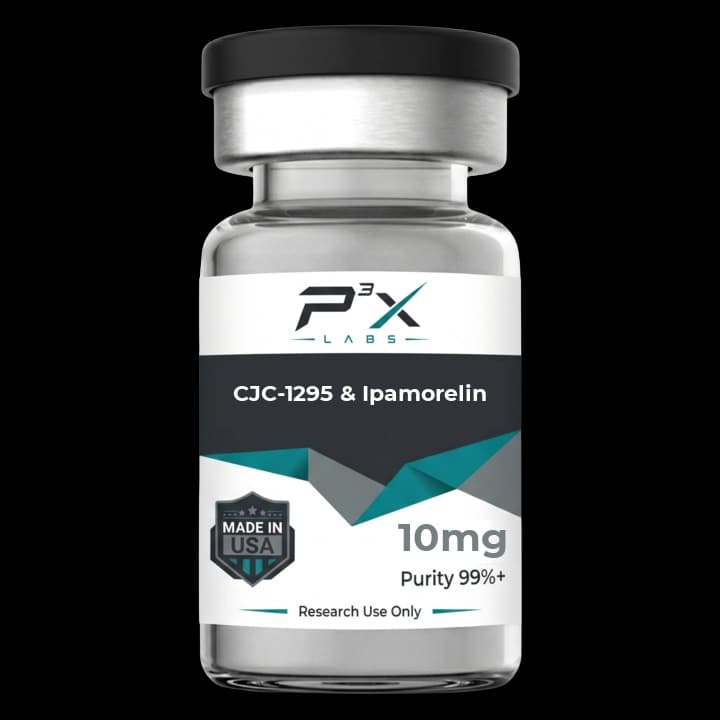
CJC-1295 & Ipamorelin Blend and Half Life Determination
studies have been conducted on test subjects to determine the half life of and individual pharmacokinetic profiles of the two peptides. In one late 1990s study, a clinical trial was conducted on eight male test subjects with a concentration escalation design. The level of growth hormones was monitored after every instance of peptide presentation.
Proposed Mechanism
At the end of the study, it was suggested by the researchers that there was a single episode of growth hormone release with the highest peak at 0.67 hours, after which there was an exponential decline up to negligible concentrations of the compound. This study concluded that the Ipamorelin peptide appeared to exhibit a short half-life of 2 hours, after which the potential action appears to begin to decline. CJC-1295 , by contrast, appears to have a much longer half-life.
Key Observations
Researchers comment that a single introduction of the peptide may upregulate growth hormone production by somatotrophs for prolonged periods of time, thus apparently contributing “ to an overall increase in [growth hormone] secretion … by 46% ” and also potentially upregulating its main anabolic mediator insulin-like growth factor-1 (IGF-1) by 45% on average. Another publication also observes that CJC-1295 may potentially upregulate “ [growth hormone] concentrations by 2- to 10-fold, ” and estimates that the half-life of the peptide ranges between 5.8 – 8.